

Why Medical Device Plastics Need More Than Dimensional Accuracy
When engineers discuss precision injection molding, dimensional accuracy is often one of the first things that comes to mind.
And for medical device components, dimensional control can be critical.
A connector has to fit.
A seal has to locate correctly.
A moving component needs the right clearance.
A fluid path needs the right geometry.
A mating surface needs to be positioned correctly.
But here is an important engineering question:
If a medical plastic component passes dimensional inspection, does that automatically mean it is a good part?
Not necessarily.
A component can be dimensionally correct and still have issues related to material compatibility, surface condition, flash, contamination, functional performance, process consistency, or validation.
That is why medical plastic components often require a much broader engineering perspective.
01 — Function Comes Before Dimensions
Dimensions are important because they support function.
Consider a medical plastic component with a sealing interface.
The drawing may specify a very tight dimensional tolerance.
But the actual sealing performance can also depend on:
- Surface condition
- Material behavior
- Geometry
- Mating components
- Assembly force
- Environmental conditions
The same principle applies to connectors, valves, fluid-handling components, moving mechanisms, and other medical assemblies.
A dimension is rarely important simply because it is a dimension.
It is important because it controls something.
Good engineering starts by identifying what the component must do—and then determining which characteristics control that function.
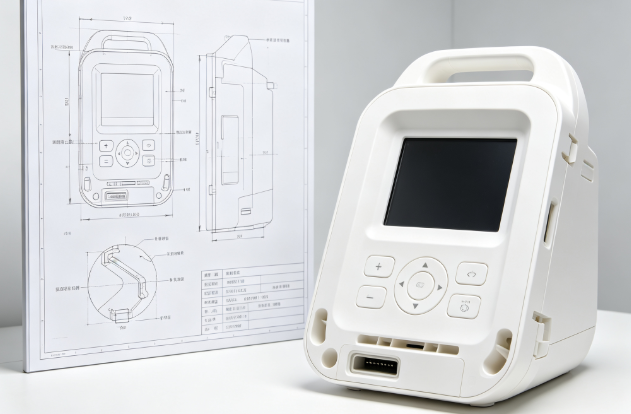
(medical plastic component and its engineering drawing.)
02 — Material Compatibility Is a Design Decision
Choosing a plastic for a medical application is not simply a matter of selecting the material with the highest strength or lowest cost.
Engineers may need to consider:
- Mechanical performance
- Chemical compatibility
- Temperature exposure
- Dimensional stability
- Environmental conditions
- Processing characteristics
- Application-specific sterilization requirements, where applicable
- Long-term performance
Material selection also affects molding.
Different materials can behave very differently during injection molding.
Shrinkage, flow behavior, cooling response, fiber orientation, and processing conditions can all influence the final component.
This means material selection and manufacturing strategy should not be treated as completely separate decisions.
The material specification becomes part of the manufacturing strategy.
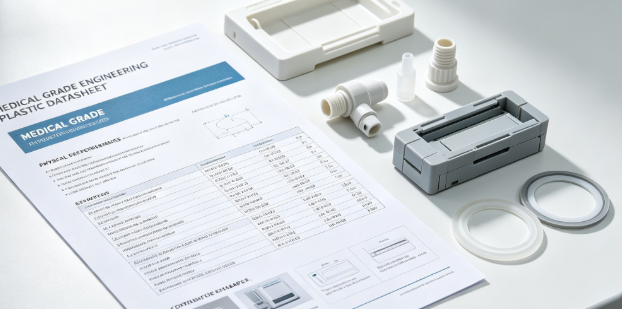
(medical-grade engineering plastic material datasheet next to actual molded production components.)
03 — Surface Quality Can Matter as Much as Geometry
When people hear “surface quality,” they often think about appearance.
For medical components, that can be an incomplete way of looking at the problem.
Depending on the application, surface characteristics can influence:
- Friction
- Sealing
- Contact with other components
- Fluid interaction
- Cleaning
- Particle generation
- Functional performance
A surface can therefore be functionally important even when it is hidden from the user.
This is one reason why tooling details such as polishing, parting-line location, venting, ejection, and mold surface condition can matter far beyond cosmetic appearance.
A surface finish requirement should be connected to the function it supports.
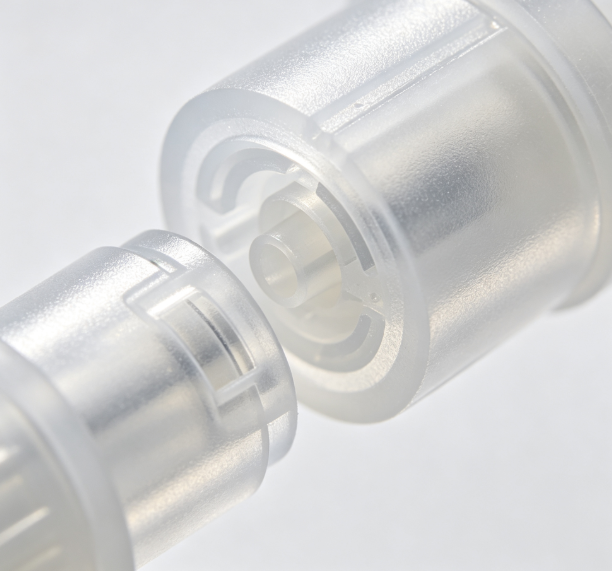
(precision molded medical component)
04 — Flash and Burrs Are Not Just Cosmetic Defects
Flash is often discussed as a visual molding defect.
But in a functional medical component, its location matters.
A small amount of material at the wrong location can potentially interfere with:
- Assembly
- Sealing
- Fluid flow
- Moving mechanisms
- Connector engagement
- Contact surfaces
The important question is therefore not simply:
“Is there flash?”
It is:
“Where is the flash, how large is it, and what function could it affect?”
This is another example of why inspection criteria should be connected to product function.
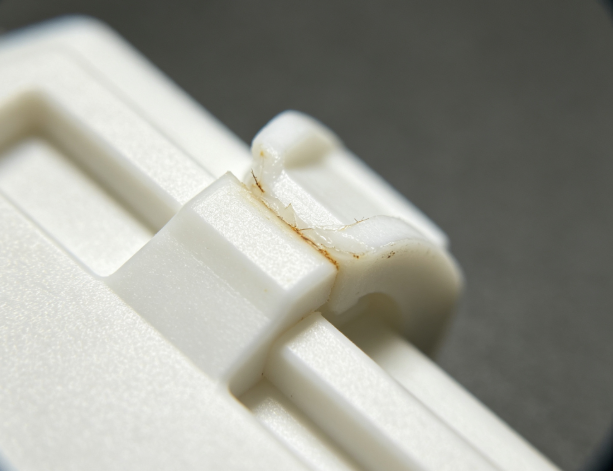
(an acceptable molded edge with flash on a precision plastic component.)
05 — Weld Lines Can Become Functional Risks
Weld lines are a normal phenomenon in injection molding.
They occur when separate flow fronts meet.
Their presence does not automatically mean that a component is defective.
But their location and characteristics can matter.
For example, a weld line located in a highly loaded area, sealing interface, pressure-related component, or critical functional feature may require engineering evaluation.
This is why weld-line prediction can be useful during product and tooling development.
The objective is not simply to eliminate every weld line.
That may not be practical.
The objective is to understand:
Where will the flow fronts meet?
What function is located there?
Does the material and process provide sufficient performance?
Should the gate or geometry be reconsidered?
06 — Cleanliness and Contamination Matter
Dimensional inspection tells us about geometry.
It does not tell us everything about the physical condition of a component.
Depending on the medical application, engineers may also need to consider:
- Particles
- Residues
- Contamination
- Handling
- Storage
- Packaging
- Manufacturing environment
The exact requirements depend heavily on the component and its intended use.
A medical device component that comes into contact with a controlled fluid path, for example, may have very different requirements from an external housing.
This is why “medical-grade” should never be treated as a single engineering requirement.
The application defines the risk.
The risk defines the controls.

(component cleanliness inspection.)
07 — Repeatability Matters More Than One Perfect Sample
Imagine a component passes every dimensional inspection requirement.
That is good.
But what happens if the next 100 parts show significant variation?
This is where production consistency becomes important.
Injection molding is a process, not a one-time event.
Variation can come from:
- Material
- Mold temperature
- Cooling
- Injection conditions
- Packing
- Cycle time
- Tool condition
- Machine variation
A single excellent sample does not automatically demonstrate a stable production process.
For precision medical components, engineers need to understand not only:
“Is this part within specification?”
but also:
“Can the process repeatedly produce parts within specification?”
08 — Validation Is Different From Inspection
This distinction is particularly important in NPD.
Inspection asks:
Does this part meet the defined specification?
Validation addresses a broader question:
Does the product and its manufacturing process consistently meet the requirements associated with its intended use?
These are not the same thing.
A CMM can tell you whether a feature is located within a specified tolerance.
It cannot, by itself, prove the entire product or manufacturing process is suitable for its intended application.
This is why medical product development requires engineering, manufacturing, quality, and validation considerations to work together.
Dimensional inspection is one piece of the system.
It is not the entire system.
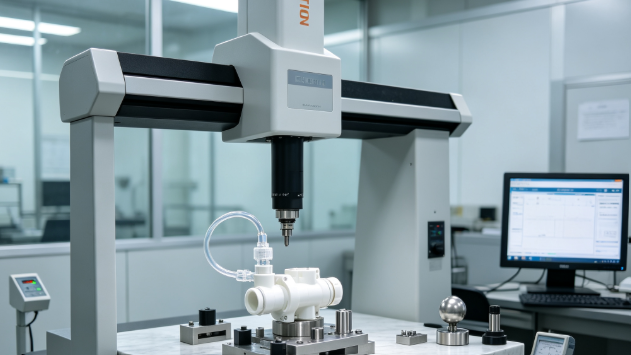
(inspection environment: CMM )
09 — Traceability and Process Control Matter
A precision component is not created only by its CAD geometry.
Its final characteristics can be influenced by:
Material → Tool → Machine → Process → Inspection → Handling
When something changes, engineers need to understand what else may be affected.
For example:
- A material grade changes.
- A mold insert is modified.
- A critical process parameter changes.
- A supplier changes.
- An inspection method changes.
Each change can potentially affect product performance or process consistency.
For controlled medical manufacturing, this makes documentation, change control, and traceability important parts of the engineering system.
The goal is not paperwork for its own sake.
The goal is being able to understand:
What was made, how it was made, and whether the process remained under control.
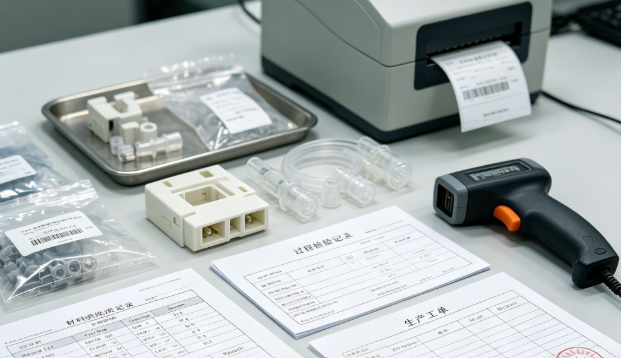
(inspection records)
10 — The Right Question Is Not “How Accurate Is It?”
This may be the most important point.
When reviewing a medical plastic component, it is tempting to focus on the numbers:
±0.05 mm
±0.02 mm
±0.01 mm
But tighter tolerance does not automatically mean better engineering.
The better question is:
Which characteristics actually determine the safety, function, reliability, and consistency of this component?
Those characteristics may include:
- Critical dimensions
- Material properties
- Surface condition
- Flash
- Weld-line location
- Sealing performance
- Mechanical performance
- Cleanliness
- Process capability
- Traceability
Some dimensions may need extremely tight control.
Others may not.
The engineering challenge is to identify the characteristics that genuinely matter.
Accuracy Is Only One Layer of Precision
A useful way to think about medical plastic components is as a hierarchy:
Dimensional accuracy
↓
Functional performance
↓
Process consistency
↓
Product reliability
↓
Application requirements
A component that measures correctly is only at the first layer.
The real engineering objective is to ensure that the component performs consistently for its intended application.
That requires coordination between:
Product Design
Material Selection
Tooling
Injection Molding
Quality
Validation
Manufacturing
The Engineering Takeaway
Medical injection molding is not simply about making plastic parts to tighter tolerances.
It is about controlling the characteristics that matter to the product’s intended function and manufacturing process.
So the next time someone says:
“The part is dimensionally perfect.”
The engineer’s next question should be:
“Good. But does it perform?”
Because in medical device manufacturing:
A dimensionally correct part is necessary.
A consistently functional part is the real objective.