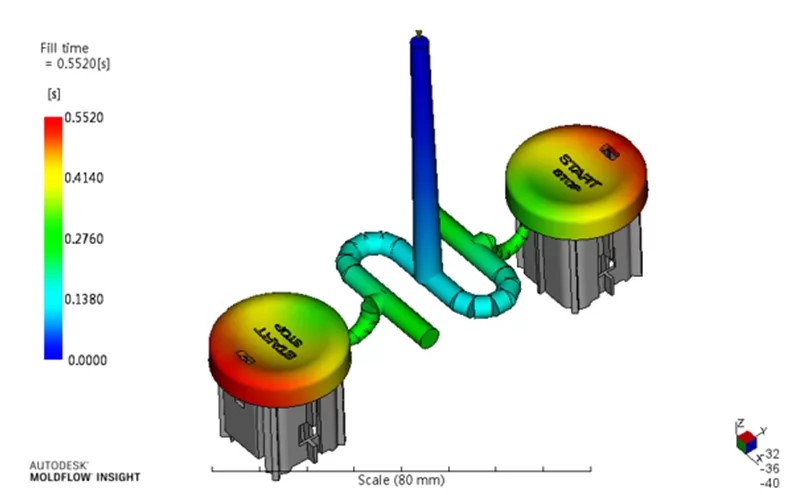
Using Mold Flow Analysis to Improve Injection Molding Design
Learn how Mold Flow Analysis helps injection molding engineers evaluate filling, injection pressure, gate location, knit lines, air traps, and material selection before tooling.



Learn how Mold Flow Analysis helps injection molding engineers evaluate filling, injection pressure, gate location, knit lines, air traps, and material selection before tooling.
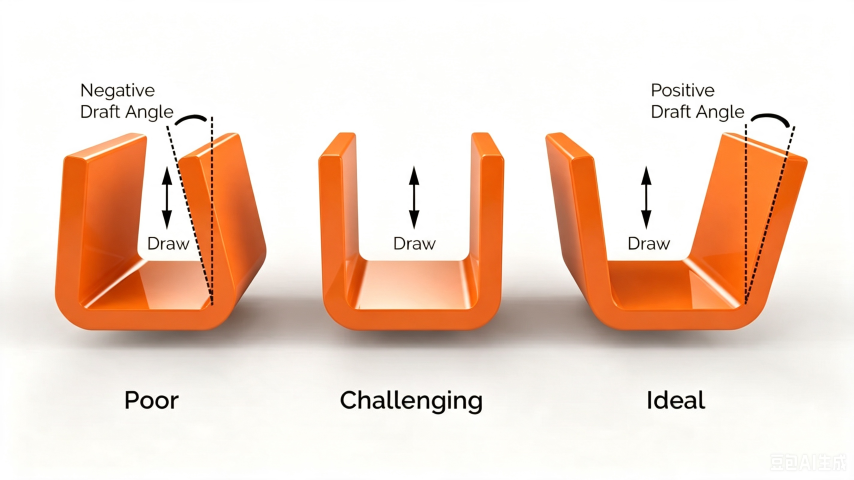
Learn why draft angle is essential in injection molding. Explore recommended draft values, texture considerations, ejection problems, and DFM guidelines for plastic part design.
A living hinge may be one of the simplest-looking features in plastic part design. It contains: Just a thin section of plastic connecting two rigid bodies. Yet despite its simplicity, the living hinge is one of the most frequently misdesigned features in injection molding. Many hinge failures occur long before the product reaches the customer.
One of the most common challenges in plastic product design is creating a reliable press fit. Consider a typical assembly: At first glance, the solution appears straightforward: Design the mating dimensions with a tight tolerance and create an interference fit. In practice, however, injection molding does not always favor this approach. Shrinkage variation, molding tolerances,
One of the most common comments during a DFM review is: “Can we add a radius here?” To many product designers, corner radii appear to be minor details. After all, a sharp corner seems simpler to design and often looks cleaner in CAD. However, sharp corners rarely benefit injection molded parts. In fact, they frequently
Every product team expects design changes during development. That is the purpose of prototyping. Engineers evaluate: And then make improvements. The problem is that not all design changes are equal. Some modifications can be completed by machining existing mold steel. Others require replacing inserts, rebuilding mold components, or manufacturing an entirely new tool. From a
One of the simplest ways to reduce tooling cost is often overlooked during product development: Instead of designing two mating parts, design one part that mates with itself. This concept is known as a self-mating part. When a part is rotated, flipped, or mirrored and can successfully assemble with an identical copy of itself, manufacturers
When discussing injection molded part design, engineers often focus on: All of these factors influence the final product. However, if there is one design principle that has a greater impact on molding success than almost any other, it is this: Maintain uniform wall thickness. In practice, many molding defects—including sink marks, warpage, voids, dimensional variation,
When discussing injection molded parts, surface finish is often treated as a cosmetic decision. Questions usually focus on appearance: While appearance is important, surface finish affects far more than aesthetics. The selected finish can influence: In many projects, the surface finish decision is made late in development. By that stage, it may already be affecting
Almost every plastic product contains molded text. Examples include: From a CAD perspective, adding text is simple. From a molding perspective, text becomes another geometric feature that must: Many text-related defects are not caused by the text itself. They are caused by text being designed without considering how molds are manufactured and how plastic behaves